The Green Book
Earl Beaumont spent the morning celebrating the birth of a son who was not his.
His wife spent it wondering whether God would forgive her for letting him.
The house was very quiet.
Samantha sat in the chair by the window with the green book open on her knee and did not write in it. Behind her the fire had burned low. Somewhere in the lane a man was drawing water from a well, and the clank of the bucket chain came up thin and clear through the morning air, and she listened to every pull.
The cradle stood within reach of her foot. Earl had made it for Lizzy, four winters ago, out of cherry wood that he had been saving for something better. He had planed the rockers until they moved without a whisper. Now they moved under her toe, once, twice, and the small sound inside it settled again.
She looked down at him.
He was asleep with his fists up beside his face, as if he had come into the world ready for an argument. His skin was still red and creased. His hair was a dark wet smear. His mouth worked on something that was not there. In an hour or a year he would look like somebody, and then she would not be able to stop seeing it.
The midwife had left at dawn. She had put on her shawl and picked up her bag, and at the door she had looked at the cradle a moment longer than she needed to. Then she had looked at Samantha. She had said nothing. She had said, “Send for me if the fever comes,” and gone down the steps and out into the cold, thin light. A woman who had delivered half the town would carry nothing out of this house but her fee.
It was a kindness. She had no idea what to do with it.
Earl had been in the yard for an hour, after. He had come back in with his eyes red and his big hands shaking, and he had knelt by the bed and said her name as though it were a prayer. Christopher, she had told him. For your father. And he had put his forehead against her arm and wept.
He was at the shop now. He had gone at seven, whistling under his breath, with a cold biscuit in his coat. At the door he had turned and looked at her, and at the cradle, and at her again, and she had never in her life been looked at with so much simple gladness.
She loved him. Nobody would believe that, if they knew, and she did not blame them. But she had loved Earl Beaumont for years, and she loved him now, watching him go off down the lane with a biscuit in his coat and a son he thought was his. She could not decide whether the kindest thing was to tell him or never to tell him, and she could not make the two come apart.
She wanted to be sick.
She sat very still instead, and when the feeling passed, she took the pencil from the spine of the book.
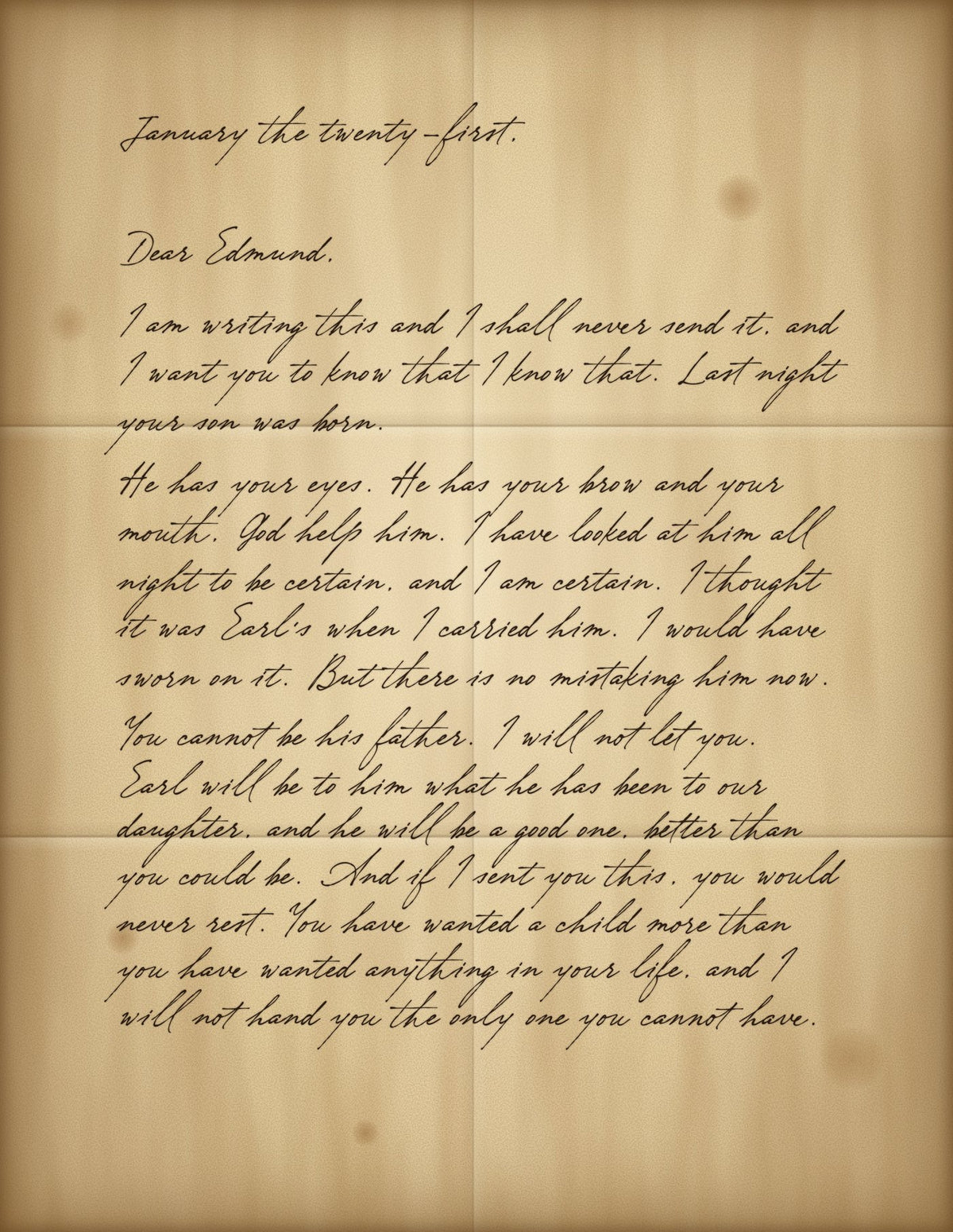
It was the book where she kept her sums. Pomade, ribbon, the price of lavender, who owed her and who had paid. Appointments written small. Her whole careful life in columns. Nobody opened it but her, and she had written in it every evening for nine years, so that its cloth was soft as a glove and shaped to her hand.
She turned past the columns. She found the back pages, where the binding fell open, and a sheet of good paper she had been saving for a letter to her sister in Charleston.
She wrote the date at the top.
Then she wrote a name, and a comma after it, and looked at what she had written.
In the cradle the baby sighed and turned his head, and she felt it in her chest, a rope drawn tight. For a long minute she held the pencil above the paper and she could not have said, if anyone had asked, whether she was about to write or about to stop.
Then she wrote.
She wrote fast, then slow, then fast again, with the pencil pressing so hard it bit through to the page beneath. Twice she stopped and pressed the back of her wrist against her mouth. Once she crossed out a line and wrote it again, plainer. When it was done she read it through once, her lips barely moving, and her face did not change at all.
The clanking at the well had stopped. The fire settled.
She folded the sheet in three, along the lines she had made without thinking, and pressed the creases flat with her thumbnail. She did not seal it. There was nobody to send it to, and nowhere to keep it that was safe.
She slid it into the back of the green book, behind the last page of sums, and closed the cover over it.
Out on the step she heard boots. Heavy, familiar, a man in a hurry to get back to a thing he loved. The latch lifted.
“Sam?” Earl called softly, so as not to wake the boy. “I brought you a bun from Hartley’s. Still warm.”
Samantha put the green book in the empty place on the shelf where it always lived. She smoothed her hair. She turned from the shelf with her face arranged, and she smiled at her husband, as though she had nothing in the world to hide.
Earl set the bun on the sill and went straight to the cradle without taking off his hat. “Look at them hands, Sam,” he whispered. “Size of shovels already. He’ll make a carpenter, you wait.”
Ten years would pass before her husband found the letter. By then the boy would call him Papa, and Bellweather would have a great deal to say about what came next.